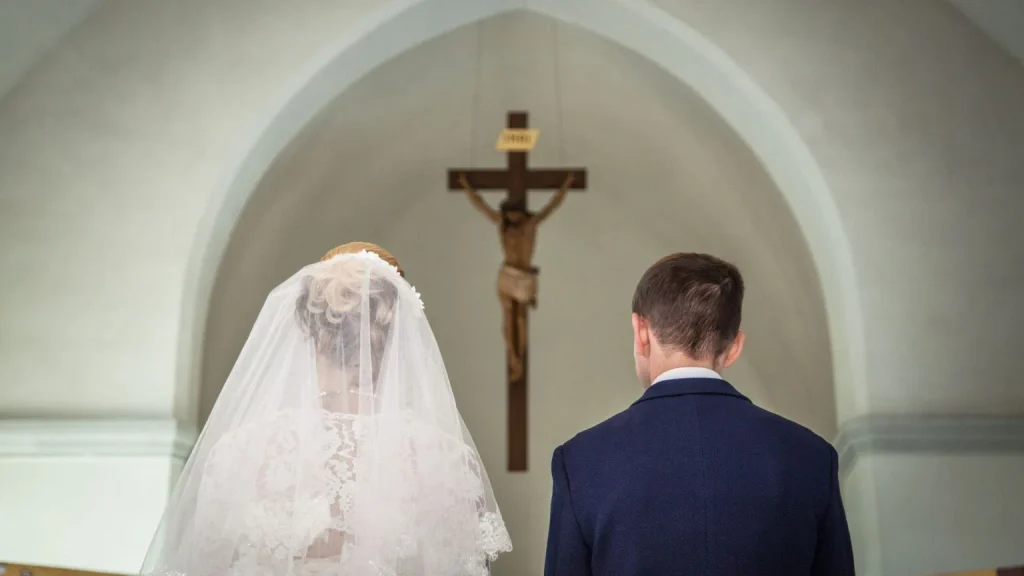

That’s a question many people ask themselves today. After all, living together before marriage has become so common that we often don’t even stop to think about it anymore. But is the fact that something has become common necessarily the truth about human nature? Is this the way God intended for us—who were created to love and be loved? Why get married in the Church?
Marriage is part of God's plan
So, when a man and a woman decide to get married, they are not simply making a personal commitment between the two of them. They are saying “yes” to a reality that God conceived, from the beginning of creation, and desired for man, for woman, and for the family. That is why we need to understand what marriage is. It is not just about living together, sharing a life, bills, a home, and plans. Something much greater is happening when a man and a woman enter into a lifelong covenant.
So, when a man and a woman decide to get married, they aren’t simply making a personal commitment to each other. They are saying “yes” to a reality that God conceived—from the very beginning of Creation—and desired for man, for woman, and for the family. That is why we need to understand what marriage is. It is not just about living together, sharing a life, bills, a home, and plans. Something much greater is happening when a man and a woman form a lifelong covenant.
Marriage is a sacrament: God takes part in the couple's life story
And here’s a second very important point: getting married in the Church isn’t just about receiving a blessing or having a beautiful ceremony. Marriage is a Sacrament. Unlike a blessing, which is bestowed upon a person, a situation, or a circumstance, a sacrament is something else entirely. It is an action of God in human lives, through which He communicates His own life and grace in a real and concrete way. This means that God is not merely being invited to attend the wedding. He enters into the lives of that couple and gives them the grace necessary to live out the vocation they have received. The Catechism tells us that the Sacrament of Matrimony signifies the union of Christ and the Church and grants the spouses the grace to love one another with the love with which Christ loved his Church (cf. CCC, n. 1661).
Look how beautiful that is! Because, if it depended solely on our own strength, we know that, often, we wouldn’t be able to love like that. There are days when it’s easy to love, but there are also days of weariness, disagreements, frustrations, hurts, and misunderstandings. That’s why the couple isn’t alone. God offers His grace so that husband and wife can learn, every day, to truly love, to forgive, to start over, and to remain faithful.
Getting married in the Church is making your “yes” public
There is yet another very beautiful aspect: Christian marriage is not merely a private decision made by the couple. It is a “yes” publicly declared before God and the Church. Why is this important? Because true love is not afraid to make a commitment. When I publicly say “yes” to you, I am saying: I choose you, I accept this covenant, and I want to walk with you.
The Church herself teaches that, because marriage is a public reality, it also requires a public celebration. Marriage introduces the couple into a new reality within the Church, with rights and duties, and the public nature of this commitment helps to protect and strengthen the spouses’ fidelity (cf. CCC, no. 1631). That is why getting married in the Church is not simply “having a ceremony.” It is committing, before God and others, to what I am choosing to live out. It is saying: “I don’t just want to live with you. I want to make a covenant with you.”
Getting married in the Church is learning to love as Christ did
And perhaps this is one of the most beautiful aspects of Christian marriage. When a man and a woman are married in the Church, they are not merely saying, “We love each other.” They are also saying, “We want to learn to love as Christ loves.” St. Paul tells married couples: “Husbands, love your wives, even as Christ loved the church and handed himself over for her” (Eph 5:25). And here we realize that marriage is much more than just a feeling.
To love as Christ loved means learning to step outside of oneself, to give of oneself, to care, to forgive, to remain faithful, and to seek the good of the other. It is a love that matures over time. And no one can live this out by their own strength alone. That is why the Sacrament is so important: God gives the couple the grace so that, little by little, they may learn to love not only in the way they are capable of, but in the way God calls them to love.
Getting married in Church is relying on God's grace
Jesus says in the Gospel: “Without me you can do nothing.” (John 15:5). These words also apply to marriage. When a couple gets married in the Church, they are not saying, “We’ll be able to handle everything on our own.” On the contrary. They are acknowledging: “We need God.” It is as if the couple were saying: “Lord, we want to live out this vocation, but we know we are limited. We need your grace to love, to remain faithful, to overcome difficulties, to forgive, and to start over.”
That is why getting married in the Church is not simply a matter of placing God in the middle of the couple. It is recognizing that, in order to fully live out what God has envisioned for marriage, the couple needs God’s presence and grace. And perhaps this is precisely what we need to rediscover: Marriage is not just a life for two. It is a vocation to be lived with God.

Ivana Brandão
Missionária da Comunidade Canção Nova
Your donation transforms lives and helps us
to continue our work of evangelization.
We use cookies to improve your experience. By continuing to browse, you agree to our Privacy Policy.
 Português do Brasil Português do Brasil
 English Português do Brasil Português do Brasil English